


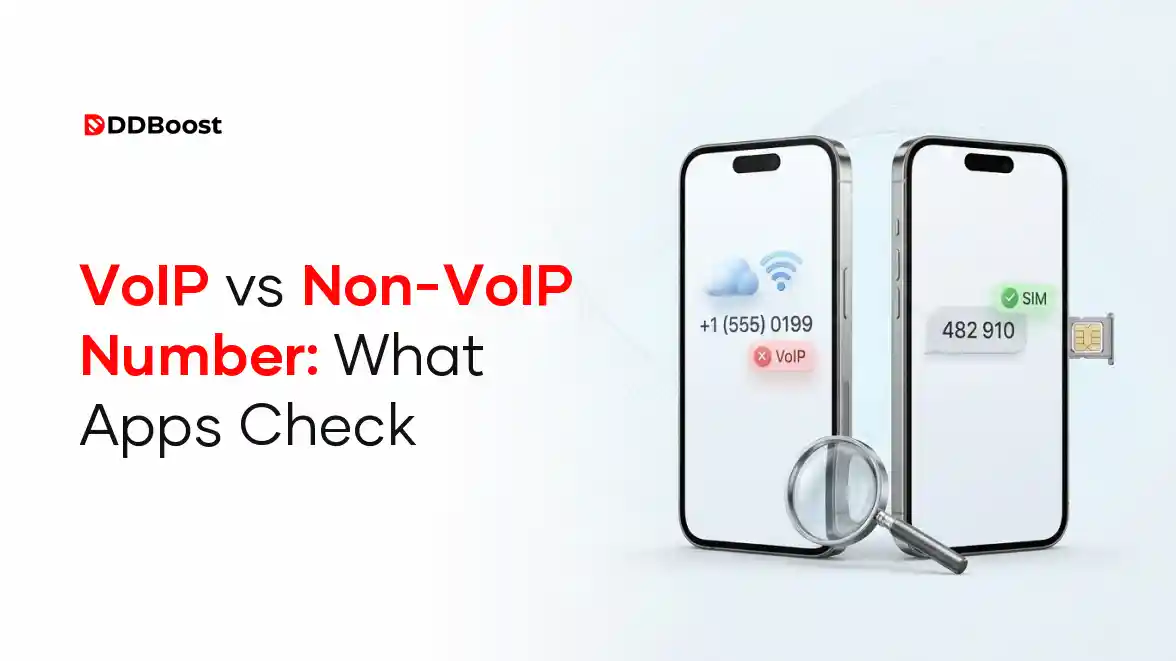
Quick answer: A non-VoIP number is a normal mobile number that runs on a real SIM card from a network like MTN or Airtel. A VoIP number lives on the internet and comes from an app, so you can get one in minutes without a SIM. Many sign-up systems check which type a number is, and they often refuse to send a code to internet numbers because they are easy to create in bulk.
What a VoIP number is
VoIP stands for Voice over Internet Protocol. In plain words, it means calls and texts travel over the internet instead of through a mobile network's towers.
A VoIP number is a phone number that lives inside an app or an online service. You open an account, pick a number, and it works over Wi-Fi or mobile data. There is no SIM card tied to it.
Google Voice and TextNow are the names most Nigerians have heard of. Business call apps used by customer care teams also give out VoIP numbers.
What a non-VoIP number is
A non-VoIP number is the ordinary kind. It belongs to a SIM card issued by a mobile network, and the network records it as a mobile line.
Your MTN, Airtel, Glo or 9mobile line is a non-VoIP number. In Nigeria, the NCC (Nigerian Communications Commission) requires every SIM to be linked to the owner's NIN (National Identification Number). That link is one reason a local SIM carries more trust than a number created in an app.
VoIP vs non-VoIP number: the main differences
| Question | VoIP number | Non-VoIP (SIM) number |
|---|---|---|
| Where it comes from | An app or online service | A mobile network, through a SIM card |
| Needs a SIM card? | No | Yes (physical SIM or eSIM) |
| Needs internet to work? | Yes | No, it works on network signal |
| How fast you can get one | Minutes, often free | You visit a network shop or agent, with ID |
| Accepted for sign-up codes | Often refused | Usually accepted |
| Good for keeping an account long term | Risky, the number can be taken back | Yes, as long as you keep the SIM active |
One thing worth knowing: there are two kinds of VoIP. "Fixed" VoIP is tied to a real address or a piece of equipment, like an office phone line. "Non-fixed" VoIP is the kind anyone can grab online with just an email. The second kind is the one that gets refused most.
How apps know your number is VoIP
Apps do not guess. Before sending a code, many of them run a quick "line type" lookup. This is a database check that says what kind of number it is.
Twilio, a large company that sends texts for apps, sells exactly this check. Its line type documentation lists answers such as mobile, landline, fixed VoIP and non-fixed VoIP. It describes non-fixed VoIP as a number "obtained online without requiring a physical device", and gives Google Voice as an example.
Once the app has that answer, it applies its own rule. Some block internet numbers outright. Some ask for extra checks. Some let them through. Each company sets this for itself and rarely says it publicly, so the same number can work on one app and fail on another.
Why apps reject VoIP numbers for verification
The reason is cost, not you. A fraudster who wants 500 fake accounts can't easily buy 500 SIM cards, because each one needs ID. Getting 500 app numbers is much simpler.
So apps treat a non-fixed VoIP number as a risk signal. Refusing it cuts down on fake accounts and spam, even though it also blocks some honest people.
Google, for example, does not explain its exact rules. Its account verification help page says that if a number "cannot be used for verification", you should try a different number, and that each number can only create a limited number of accounts. We cover that exact error in our guide on fixing "this phone number cannot be used for verification".
Which one should you use?
Here is how I would decide, based on what the account is for.
- Your bank, your main WhatsApp, your main email: use your own SIM number. If you ever lose access, the recovery code goes to a number only you control.
- A business line you want to keep private: a second SIM is usually the safer choice. A VoIP number can be fine for calls with customers, but don't make it the login number for important accounts.
- A one-time sign-up you don't plan to log into often: a temporary number can work, if the app accepts it. Expect some apps to refuse it.
The common mistake is signing up for an account you care about with a free app number, then losing that number. Free VoIP numbers are often taken back after a period of no use, and someone else can be given the same number later. If that happens, a password reset code could go to a stranger.
If you are weighing a second SIM against a virtual number, our comparison of virtual number vs second SIM walks through the trade-offs.
What to do when your number is rejected
- Check the format. Pick Nigeria (+234) as the country and drop the first 0. So 0803 123 4567 becomes 803 123 4567.
- Try your own SIM number. If you were using an app number, switch to your MTN, Airtel, Glo or 9mobile line.
- Wait before trying again. Asking for many codes in a short time can lock you out for some hours.
- Check whether the number is already in use. Many apps allow one account, or only a few, per number.
- Use the app's own help page. If a real SIM number still fails, the app's support team is the only one that can tell you why.
Do not pay anyone on social media who claims they can "clear" a blocked number or force a code through. That is a common scam, and some of these people ask for your code so they can take over your account.
If you only need a number to receive a single sign-up code, DDBoost sells virtual numbers from many countries. Each number is for one activation, and the app shows which countries and apps are listed. No seller can promise that every app will accept every number, so keep important accounts on your own SIM.
Common questions
Is a VoIP number a virtual number?
Yes, a VoIP number is one kind of virtual number. "Virtual number" is the wider term for any number not tied to a SIM in your phone. Some virtual numbers are VoIP. Others are real mobile lines that a provider holds for you and passes the text on.
Is my MTN or Airtel number VoIP?
No. A line from a Nigerian network on a SIM card or eSIM is a mobile line, so it is non-VoIP. If an app rejects it, the cause is something else, such as a wrong format, too many code requests, or the number already being used on another account.
Is TextNow a VoIP number?
Yes. TextNow numbers work over the internet through an app, so line type checks usually mark them as VoIP. That is why many apps, including some banks and social media platforms, refuse to send verification codes to them.
Can I use a VoIP number for WhatsApp?
Sometimes it registers, often it doesn't, and it is risky even when it works. If you lose the number, you can lose the account. Our guide on using a virtual number for WhatsApp explains the long-term risks.
Why does the same number work on one app but not another?
Each app sets its own rules. One may block all internet numbers, another may only ask for an extra check, and a third may allow them. Apps also limit how many accounts one number can open, so a number can be refused simply because it was used before.