


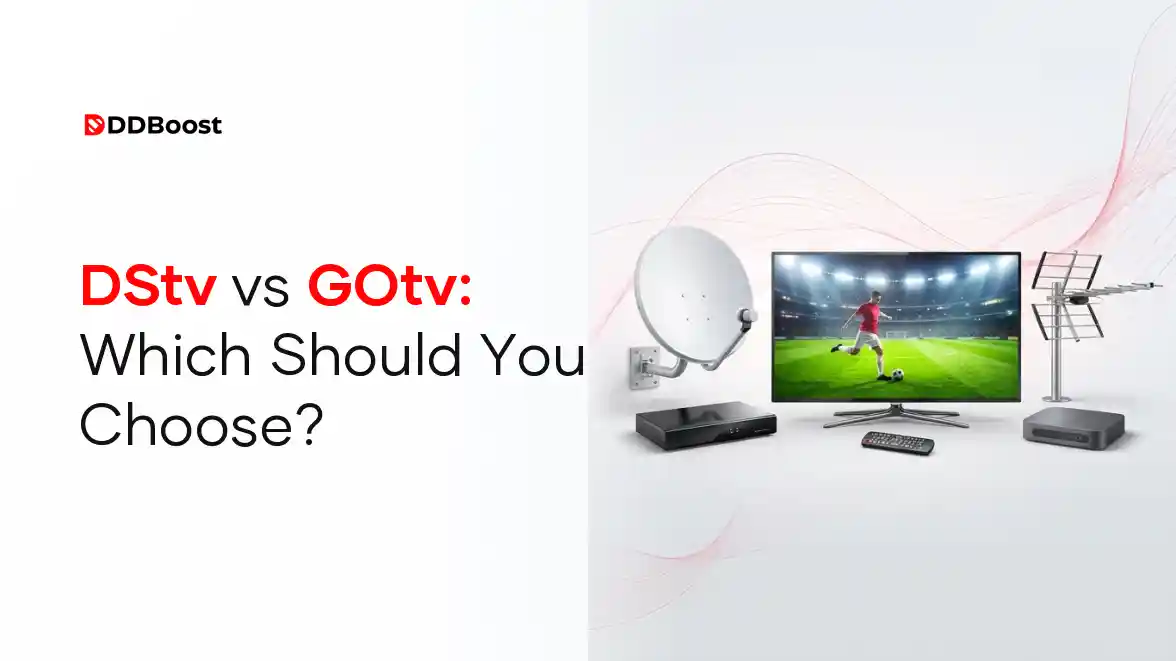
Quick answer: In the DStv vs GOtv choice, the first question is not price. It is whether GOtv signal reaches your area. If it does and you mostly watch local channels, movies and some football, GOtv costs less and is simpler to set up. If you live outside GOtv coverage, or you want the widest sports and channel list, DStv is the better pick.
What is the real difference?
Both services come from the same company, MultiChoice. The big difference is how the signal gets to your TV.
DStv uses satellite. A dish on your roof or wall catches the signal from space, so it works in most places with a clear view of the sky, including villages and new estates far from big towns.
GOtv uses terrestrial signal, meaning it comes from TV masts (tall transmitters) on the ground. You only need a small antenna, but you must live within range of a GOtv transmitter. The closer you are, the stronger the picture.
That one fact explains most of the other differences: the setup, the cost, how each behaves in rain, and who each one suits.
DStv vs GOtv side by side
| Point | DStv | GOtv |
|---|---|---|
| How signal arrives | Satellite dish | Antenna from local transmitter |
| Where it works | Most places with open sky | Only towns with GOtv coverage |
| Setup | Dish must be mounted and aimed, usually by an installer | Antenna, often a do-it-yourself job |
| Monthly cost | Higher at every level | Lower at every level |
| Channel choice | Wider, more HD, more sport | Smaller list, strong on local and family content |
| Heavy rain | Picture can cut out for a while | Rain is usually less of a problem |
| Moving house | Dish must be removed and refitted | Easy, if the new area has coverage |
Prices and channel lists change often, so this post does not quote them. Check the current packages on the official DStv and GOtv sites or apps before you pay.
Check these four things before you buy
- Coverage. Ask neighbours who use GOtv how their picture is, or ask an accredited GOtv agent near you. If nobody around you gets clear GOtv signal, the decision is made: choose DStv.
- What you actually watch. Write down the 3 or 4 channels your household cannot live without. Then look for them in the channel list of the package you plan to buy, not just in the brand.
- Football. If live Premier League matches every weekend matter to you, compare the sports channels on each package carefully. Lower packages on both services carry far fewer matches.
- Your monthly budget. Pick the package you can renew every month without stress. A bigger package you keep letting lapse gives you less TV than a smaller one you keep active.
When GOtv is the smarter choice
- You live in a city or town where GOtv signal is strong.
- You rent, or you may move soon. Taking an antenna with you is far easier than moving a dish.
- Your family mostly watches Nollywood, local news, kids' shows and music channels.
- You want a second TV service for a shop, a boys' quarters or a parent's room without paying DStv prices.
The common mistake is buying GOtv in an area with weak signal, then blaming the decoder. A poor signal shows up as freezing, blocky pictures or a "no signal" message. Fixing it usually means moving the antenna higher and outdoors, away from tall buildings and trees, and pointing it towards the nearest transmitter. If that still fails, the area may simply not be covered well.
When DStv is worth the extra money
- You live outside GOtv coverage. DStv may be your only real pay TV option.
- Sport is the main reason you pay for TV, and you want the most matches and leagues.
- You want more international channels, more HD channels, or a bigger movie and series selection.
- You own your home, so the one-time dish installation is not wasted when you move.
DStv is not worth it if you only end up watching two or three channels that a cheaper GOtv package also carries. Many homes pay for the bigger service out of habit. Look at what you watched last month before you renew.
What happens to DStv when it rains?
This is the downside many first-time DStv users do not expect. According to DStv's own help pages, satellite signals get weaker as they pass through raindrops. Drizzle and normal rain should be fine, but heavy downpours can cut the picture for a while. DStv calls this "rain fade".
When it happens you may see an error such as E48-32 on screen. Usually you just wait for the rain to pass and the picture comes back. If you lose signal even in light rain, DStv says the dish may need adjusting, so call an accredited installer. You can read DStv's explanation on its rain and signal help page.
In the rainy season this matters most for football fans. A storm during a big match can cost you part of the game, so a well-aimed dish of the size DStv recommends is not a place to cut corners.
Can you switch from GOtv to DStv later?
Yes, but not with the same equipment. The decoders are different, and a GOtv decoder cannot read a satellite signal. Switching means buying a DStv decoder and dish and paying for installation. Going the other way means buying a GOtv decoder and antenna.
So if you are not sure, start by testing coverage and thinking about the next year or two, not just this month. Buying the wrong one and switching soon after is the most expensive path.
Paying and renewing without stress
Both services are paid in advance. When the subscription runs out, the channels go off until you pay again. To renew, you need the number on your decoder (the IUC or smartcard number). If you are not sure where to find it, our guide on how to find your IUC number walks you through it.
Two habits save a lot of trouble:
- Double-check the decoder number before you pay. Paying into the wrong number is hard to reverse.
- Leave the decoder on and tuned to a channel after paying, so the signal can activate it. If channels stay off, see our post on what to do when your decoder is not working after payment.
Be careful with people on WhatsApp or Facebook offering "lifetime" or very cheap DStv and GOtv subscriptions. These offers are a common way to lose money. Only pay through official channels or a platform you trust that gives you a receipt.
If you already use DDBoost, you can pay your DStv or GOtv subscription from your naira wallet on the DDBoost services page, and every payment comes with a receipt in your history.
FAQ
Is GOtv cheaper than DStv?
Yes. At every package level, GOtv costs less per month than DStv, and the antenna setup is cheaper than mounting a dish. The trade-off is fewer channels, less sport and the need for transmitter coverage in your area. Check both official sites for current prices, because they change often.
Can I use a GOtv decoder with a DStv dish?
No. The two systems use different technology. A GOtv decoder receives signal from ground transmitters through an antenna, while DStv uses a satellite dish and its own decoder. To switch, you need the matching decoder and receiving equipment for the new service.
Which is better for football, DStv or GOtv?
DStv usually carries more live football, more leagues and more matches in HD, especially on its higher packages. GOtv's top packages show a good number of matches, but fewer. Check the sports channels listed for the exact package before paying, since line-ups change.
Does rain affect GOtv?
Rain is mostly a satellite problem, so GOtv is affected far less than DStv. GOtv picture problems usually come from weak signal instead: being far from a transmitter, an indoor antenna, or tall buildings and trees blocking the way. Moving the antenna higher and outdoors often helps.
Does GOtv work in my village?
Only if a GOtv transmitter covers it. GOtv is mainly available in cities and large towns, and coverage expands over time. Ask neighbours who use it or a GOtv agent nearby before you buy. If there is no coverage, DStv is the practical option.