


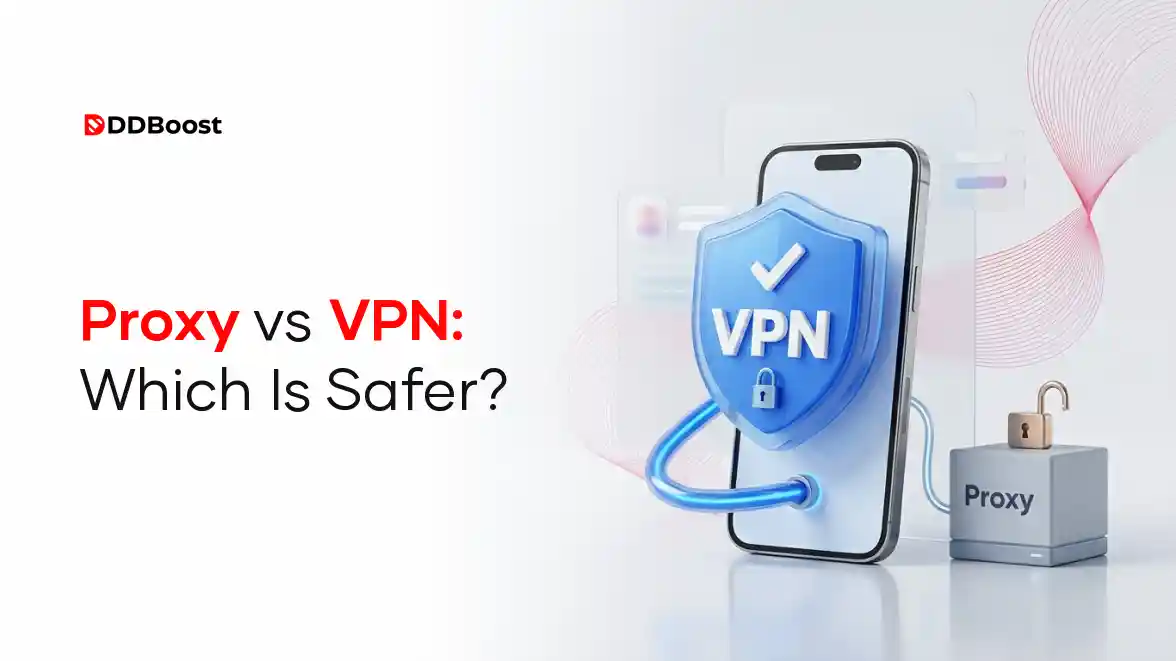
Quick answer: a proxy and a VPN both send your internet traffic through another server, so websites see that server's address instead of yours. The big difference in proxy vs VPN is protection: a VPN scrambles (encrypts) everything your phone or laptop sends, while most proxies only change your address for one app and leave your data readable.
If you want privacy or safety on public Wi-Fi, use a VPN. If you only need a website to see a different location in one browser, and you are not sending passwords or payment details, a proxy can do the job. The rest of this post explains why, in plain terms.
What is a proxy?
A proxy is a middleman server. Your browser sends a request to the proxy, the proxy fetches the page for you, then passes it back. The website only sees the proxy's IP address (the number that identifies a device on the internet), not yours.
Most proxies are set up inside one app. You type the proxy's address and port number into your browser or your phone's Wi-Fi settings, and only that app or connection uses it. Everything else on your device still goes out normally.
Common types you will see:
- HTTP or HTTPS proxy: handles web pages in a browser.
- SOCKS proxy: can carry other kinds of app traffic, but still does not add encryption by itself.
- Web proxy: a website where you paste a link and it opens the page for you.
What is a VPN?
A VPN (virtual private network) is an app that builds a protected tunnel between your device and a VPN server. Everything your device sends goes through that tunnel: WhatsApp, your bank app, your browser, app updates, all of it.
The key word is encryption. Encryption turns your data into scrambled code that only your device and the VPN server can read. So the owner of a café Wi-Fi, someone snooping on the same network, or your internet provider can see that you are connected to a VPN, but not what you are doing inside it.
Proxy vs VPN: the main differences side by side
| Question | Proxy | VPN |
|---|---|---|
| Hides your IP address from websites? | Yes | Yes |
| Encrypts your data? | Usually no | Yes |
| Covers which apps? | Usually one app or browser | The whole device |
| Setup | Type an address and port by hand | Install an app and tap connect |
| Safe on public Wi-Fi? | Not for logins or payments | Much safer |
| Speed | Can be slightly quicker (no encryption work) | A small slowdown, often hard to notice on a good server |
| Free versions | Very common, often risky | Exist, often limited or risky |
The short version: a proxy changes where you appear to be. A VPN changes where you appear to be and locks up what you send.
Which is safer, a proxy or a VPN?
A trustworthy VPN is safer, and it is not close. With a normal proxy, anything that is not already protected by the website itself can be read by the proxy owner. You are handing your traffic to a stranger's server.
That matters most with free proxies found through a quick search. You usually have no idea who runs them. A free proxy can log the sites you visit, inject adverts into pages, or try to capture what you type. If you would not give a stranger your phone to browse with, do not route your browsing through a stranger's free proxy.
A VPN is not magic either. The VPN company can see your traffic leave its servers, so you are moving your trust from your network to the VPN provider. Pick one that clearly states it does not keep logs of your activity, and avoid apps with no clear owner or that ask for odd permissions like your contacts.
What neither one does
- Neither stops you from typing your password into a fake login page. Phishing still works.
- Neither makes you anonymous once you log in to Google, Instagram or your bank. Those services know it is you.
- Neither removes viruses from your phone.
When a proxy is enough
A proxy makes sense when the task is small and nothing private is involved. For example:
- A school or office network that requires you to use its proxy to get online. Here the proxy is set up by the network owner, and you should follow their rules.
- Checking how a public web page looks from another country, with no login involved.
- A developer or tester who needs one tool to send requests from a different address.
If any of those involve typing a password, a card number or a one-time code, switch to a VPN or a trusted network instead.
When you should use a VPN instead
These are the everyday Nigerian situations where a VPN is the better choice:
- Public Wi-Fi: airport lounges, hotel Wi-Fi, campus hotspots, a restaurant network with no password. Anyone on the same network may be able to watch unprotected traffic.
- Banking or paying online on a shared network: a VPN adds a second layer on top of the bank's own security.
- Using several apps that need protection at once: a proxy in Chrome does nothing for your email app or WhatsApp. A VPN covers them all.
- A small business with staff working from different places: a VPN gives everyone the same basic protection on whatever network they are on.
One thing to plan for: a VPN uses slightly more data than browsing without it, because encryption adds a little extra to every request. If your bundle already seems to vanish, read our guide on why your data finishes fast before you leave a VPN on all day.
Managing several accounts safely
Many people search for proxies because they run more than one legitimate account. A shop with an Instagram page and a TikTok page. A family sharing one laptop. A social media manager handling three clients.
For this, a proxy is rarely the real answer. What actually keeps several accounts organised and safe is simpler:
- Use separate browser profiles. Chrome, Edge and Firefox let you create a profile for each person or business, so logins and cookies (small files that keep you signed in) do not mix.
- Give each account its own email and a strong, different password. A password manager makes this painless.
- Turn on two-step verification so a stolen password alone cannot open the account.
- Use the platform's own team tools. Meta Business Suite and similar tools let you add staff without sharing one password.
- Use a VPN on public networks when you log in away from home or the office.
One honest warning: platforms set their own rules on multiple accounts. Using proxies to make many accounts look like different people is against the terms of most social apps and can get every account banned. Read the rules of the platform you use and stay inside them.
How to choose and set up a VPN
When you compare VPNs, check these before you pay:
- A clear no-logs policy written on the provider's site.
- Apps for the devices you actually use (Android, iPhone, Windows, Mac).
- Servers in the countries you need, plus some close to Nigeria for better speed.
- A known company behind it, not an app with no website or contact details.
Setting one up takes a few minutes. Our step-by-step guide on how to use a VPN on Android and iPhone walks you through it.
If you would rather pay in naira than hunt for a dollar payment method, you can buy a VPN subscription plan for your phone or computer from the DDBoost dashboard using your wallet balance.
Proxy vs VPN: common questions
Does a proxy hide my IP address?
Yes, a proxy hides your IP address from the websites you visit through it. It does not hide your activity from the proxy owner, and it usually does not hide it from your network either, because most proxies do not encrypt your data.
Is a VPN better than a proxy?
For privacy and safety, yes. A VPN encrypts all traffic from your device, while a proxy usually covers one app with no encryption. A proxy is only "better" for a small task in one browser where speed matters more than protection.
Can I use a proxy and a VPN together?
You can, but most people do not need to. Stacking them can slow your connection and makes problems harder to fix. For normal use, a good VPN on its own gives you the protection that matters.
Are free proxies safe to use?
Mostly no. With a free proxy you rarely know who runs it, and they can see your unprotected traffic, log it, or add adverts. Never log in to email, banking or social media through a free proxy you found online.
Does a VPN use more data than a proxy?
A little, yes. Encryption adds a small amount of extra data to everything you send and receive. On a normal bundle the difference is modest, but heavy streaming over a VPN will still eat your data quickly.
Will a VPN make me completely anonymous?
No. A VPN hides your IP address and protects your data on the network, but sites you log in to still know who you are. Cookies, your accounts and what you share all identify you. Think of a VPN as protection, not invisibility.